Justin Ferriman didn’t set out to build one of the most successful WordPress plugins of all time. In fact, he didn’t even consider himself a developer.
But with a deep background in eLearning and a sharp eye for market opportunities, he turned a gap in the WordPress ecosystem into a multi-million-dollar business.
LearnDash, the popular learning management system (LMS) plugin for WordPress, wasn’t born in a startup environment. Instead, it came from a hotel room, a blog with a signup form, and a simple idea: “What if WordPress could power online courses?”
“I was more scrappy and I knew the industry better … I was an eLearning expert, so I was able to speak the language, be more pointed in my marketing, and then also move a little bit quicker… that was a big part of why we did so well.”
Justin Ferriman – Founder of LearnDash
In this interview, Justin shares how he went from blogging about eLearning in his spare time to building a global product used by course creators, universities, and Fortune 500 companies.
His story is a masterclass in market research, consistent marketing, and paying close attention to your customers. Keep reading to learn all about it!
📣 This is our series, #MyWordPressStory, which brings you insights from some of the most successful leaders in the WordPress industry.
If you’d like to be featured in our interview series – whether you’re a plugin developer, founder, or SEO expert – feel free to reach out and let us know through our contact form.
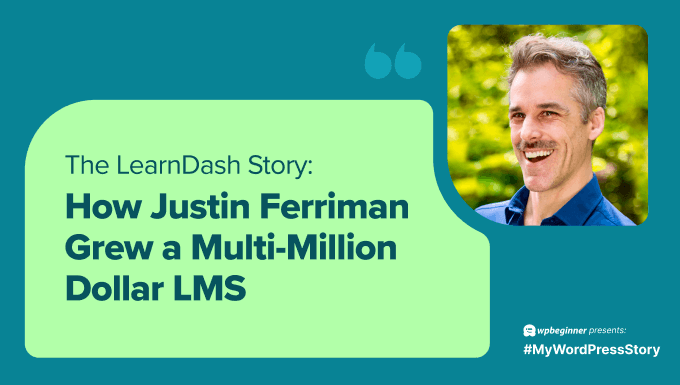
Video Interview with Justin Ferriman
If you’d like to check out our full interview with Justin Ferriman, you can watch it below:
Otherwise, you can use the links below to read more:
🙋 Meet Justin Ferriman: From eLearning Consultant to WordPress Founder
Before founding LearnDash, Justin Ferriman didn’t work in tech, and he definitely didn’t consider himself a developer.
His career began in the corporate eLearning world, where he helped Fortune 500 companies and U.S. government agencies build online training programs.
He first started using WordPress in college to blog about politics and religion.
Later, he tinkered with themes and plugins to build simple websites for family members.
But it wasn’t until years later that those skills and interests would come together in a meaningful way and help him achieve his dream of leaving the corporate world.
💡 Early Days: A Corporate Consultant Finds a Market Gap
Due to his background in eLearning consulting, Justin had deep insight into how organizations think about LMS tools – and what they find frustrating.
One day, after a client meeting, he started wondering if WordPress could be used to build a more flexible LMS. He searched the plugin directory, but nothing came up.
“I kind of googled WordPress LMS. I went to the plugin repo, there was nothing.”
Sensing an opportunity, Justin started a blog in 2012 to explore the idea of building an LMS on WordPress.
The blog was mostly about trends in online education and instructional design.
During his free time, often in hotel rooms while traveling for work, Justin covered eLearning topics that were cutting edge at the time, like gamification.
And he added one important detail, a call-to-action at the top that said: “Enter your email to be notified when WP LMS releases.”
“I didn’t know if I was going to create it, but I just put this up there, and I started getting people signing up.”
Visitors started subscribing to learn more about a piece of software that didn’t even exist yet.
First a few, then dozens, and eventually over a thousand.
“After getting like 1,000 or 1,500 people, I was like, this is something serious.”
At WPBeginner, we’ve seen many successful founders start this way: testing an idea through consistent content and building an audience before there’s even a product.
It’s one of the smartest ways to validate demand, because you’re growing in public.
So, for Justin, the feedback was clear. People wanted what he was imagining. Now, he just had to build the first WordPress LMS.
🚀 Betting on the Idea: A Midnight Launch and Early Momentum
Encouraged by the response, Justin began outlining how the product should work. He wasn’t a developer, so he created detailed specs and hired an agency to bring the vision to life.
In January 2013, LearnDash launched at midnight.
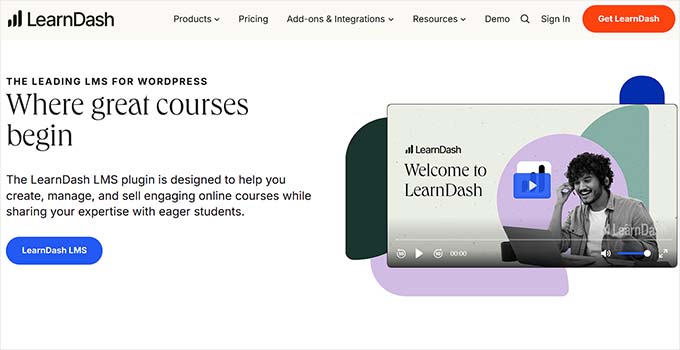
“I launched my product at like, midnight… I woke up to thousands of dollars.”
Still, the early days weren’t all smooth sailing.
Justin watched sales go down after the initial launch buzz. But then, on an ordinary weekday, things shifted.
“One day in March, I made $690 with no promotion. That’s when I knew – if I can do that without giving it full-time attention, imagine what could happen if I did.”
Four months after launch, Justin left his corporate job to fully dedicate his time to growing LearnDash.
📈 Scaling Smart: Letting Go and Leveling Up
At first, Justin handled everything: marketing, support, and strategy. That hands-on approach helped him deeply understand his customers.
It also gave him direct insight into the pain points that needed fixing, both in the product and the messaging. “It created a connection between me and the customer”, Justin told us.
But over time, that level of involvement became a bottleneck. So Justin did what many solo founders struggle with – he started to delegate.
“I tell people now, hire quicker than I did.”
Letting go of support tasks allowed him to focus on big-picture strategy, like the release of LearnDash 3.0 in 2019.
With more space to focus, he led one of LearnDash’s biggest product updates: version 3.0. This release was about more than features. Instead, it reflected a deeper understanding of how people learn online.
He introduced “Focus Mode,” a clean, immersive experience that put the learner front and center. LearnDash also made it easier for course creators to deliver structured content more efficiently.
“I wanted to know what was working in online education – not just what was trendy in WordPress.”
The result? Soon after, LearnDash 3.0 launched alongside a reasonable price increase, resulting in a 22% revenue jump.
🧠 Unfiltered Advice: What Every WordPress Founder Should Know
For Justin Ferriman, the success of LearnDash wasn’t about perfect code. In fact, he freely admits the early versions were rough under the hood.
But that didn’t matter. What did matter was clear messaging, consistency, and building trust with customers from day one.
“Code doesn’t matter 100%… the marketing did what it was supposed to do.”
He didn’t have the technical skills to build the plugin himself, but he understood the problem better than anyone. And he knew how to communicate the solution in a way that resonated with the user base.
“It’s easier to learn to market than it is to code,” Justin explained.
That may sound controversial, especially to seasoned developers.
But if you’re a non-technical entrepreneur with a strong idea and a deep understanding of your audience, this should be empowering.
That said, taking this approach doesn’t mean your journey will be faster or easier.
Justin blogged for nearly a year before he ever launched LearnDash. He wrote every line of sales copy himself. He personally answered emails from early users.
And most importantly, he spoke their language – something no amount of clean code could replace.
“The thing that will sell somebody is not an AI conversation – it’s the human part.”
That human-first approach wasn’t just smart – it helped LearnDash stand out in a growing crowd of LMS tools.
In fact, the products that stand out aren’t always the ones with the most features—they’re the ones built with clarity, purpose, and a human touch.
💥 Related Post: Looking for more inspirational founder stories? Check out our interview with Tobias Bäthge.
🚚 Selling LearnDash: Lessons Learned and Knowing When to Leave
In 2021, Justin sold LearnDash to Liquid Web. The plugin was still growing, but behind the scenes, he felt a shift.
“My heart was not in it… I dreaded doing the LearnDash thing.”
He realized that continuing without passion wasn’t fair to his team or his customers.
So, he made the decision many founders struggle with – he decided to leave.
Looking back, Justin credits that move to intuition and timing. He exited during the post-COVID eLearning spike, just before tech acquisitions began to slow down.
“I exited at a great time… but more importantly, I knew the company deserved fresh energy.”
After stepping away, Justin explored other ideas – including a software tool called Gap Scout. But he shut it down after realizing something was missing: joy.
“It still gets signups every day,” he shared, “but I didn’t really care about AI or the software. I wasn’t passionate about the problem.”
We then asked what he would do if he had to do it all again, and what advice he would give to others. In response, he said you should make sure to choose something you’re passionate about or deeply interested in.
For him, that was eLearning, and he still stays connected to the space today, through LinkedIn and industry research.
Apart from that, Justin also now works as a business coach, sharing his valuable experience with others. He’s also taken time to slow down and enjoy life a bit more.
“I’ve kind of gotten into, like, just mindfulness and things like that… it’s easy to always be thinking ahead as an entrepreneur. But it’s important to stop.”
He’s not done building. But he’s more selective now and focused on ideas that align with his values, strengths, and sense of purpose.
This is a stage many founders reach. Walking away isn’t a loss—it’s often where clarity, creativity, and long-term impact really begin.
👉 Related Post: Wondering about LearnDash competitors today? Check out our list of the best WordPress LMS plugins.
💭 Final Thoughts: The Power of Consistency and Vision
Justin Ferriman didn’t grow LearnDash by chasing trends or copying competitors.
He grew it by doing something that often gets overlooked: he listened, he showed up consistently, and he solved a real problem for a specific audience he knew well.
Besides choosing something you’re genuinely passionate about, one of Justin’s biggest takeaways was the power of an engaged audience.
“If you build an audience, you can build anything.”
He wasn’t the most technical founder. But he understood his market better than anyone, and he built a product and brand that reflected that empathy.
And even after a successful exit, Justin hasn’t stopped learning. He remains active in the eLearning space, sharing insights and observations about where the industry needs to evolve.
Today, you can find him on LinkedIn, where he regularly posts about online learning, product strategy, and the realities of founder life.
If you’re building something in WordPress – or just figuring out your next move – he’s a leader worth following.
📚 Bonus: WordPress Resources for Aspiring Founders
Are you ready to build your first WordPress business? Here are some beginner’s guides and inspirational articles to help you get started:
If you liked this article, then please subscribe to our YouTube Channel for WordPress video tutorials. You can also find us on Twitter and Facebook.
این خبر را در ایران وب سازان مرجع وب و فناوری دنبال کنید
جهت ادامه مقاله اینجا را کلیک نمایید
ایران وب سازان مرجع وب و فناوری