Like it or not, social media is ingrained in our everyday lives. People use it to share their happy moments and grievances, ask questions, and even find jobs while employers market themselves and connect with their buyers.
This is all fine and dandy, but what happens if someone posts about work or voices a contrasting personal opinion? This murky middle ground is why having a social media policy is so important for your business.

Well-thought-out corporate social media policies help keep a company’s presence consistent and scalable, no matter who posts or where. Yet, 45% of companies still don’t have one in place. I’m here to help fix that.
Let’s break down how to create a social media policy that is right for your team and look at some examples done well.
Table of Contents
- What is a social media policy?
- Why is having a social media policy important?
- Components of a Social Media Policy
- How to Create a Social Media Policy
- 8 Examples of Great Social Media Policies
Does more than one person manage your social media accounts? Do you expect your employees to promote your business on their personal profiles? Or would you rather they don’t discuss office culture or their day-to-day period at all?
In organizations with a large online presence or well-established public images, a social media policy helps answer these questions and set guardrails for how the company should be represented.
Think about it: Every person you hire has their own personality, tone of voice, and views. That may even be the reason you hired them. But the truth is, we live in volatile times.
There is much political and societal unrest, and things get complicated when an employee’s views or even behavior after hours contrasts with those of the organization, its values, or its buyers.
Corporate social media policies help combat and navigate these situations. They can also help ensure that personal views don’t seep into posts on your brand’s social media accounts either.
Now, I know. Some of you may be worried that enforcing strict rules in a social media policy stifles creativity or restricts freedom of speech.
But if done correctly, it shouldn’t hinder employees. In fact, it should make them feel more comfortable amplifying your social media messages since they’ll know exactly what will or won’t be beneficial. They don’t have to guess.
Why is having a social media policy important?
Good social media policies remove ambiguity. They give teams a single, documented playbook to follow and ultimately help every post about the company align with a brand’s values, tone, and goals.
Also, while no one wants their social media policy to be grounds for disciplinary action, it does give businesses somewhat of a safety net should things go awry.
I witnessed the importance of this first-hand during a presidential election at a previous employer.
We didn’t have a social media policy at the time, and my teammate posted something politically charged on their personal profile. Some third-party partners saw the post and were upset, putting the company in a difficult spot.
This likely could have been avoided if a social media policy had been established.
Benefits of a Corporate Social Media Policy
To get more granular, here are a few major benefits of creating a corporate social media policy:
- Maintain consistency of brand voice, tone, and messaging across social channels
- Prevent a public relations (PR) crisis as a result of a potentially offensive post
- Enable employees to handle legal and regulatory issues with sensitivity
- Protect the data privacy of customers and stakeholders
- Have effective responses at the ready for crises or data breaches if they do occur
- Ensure each new employee will have the tools to create a positive, consistent, and valuable brand message across social channels
So, what does a great social media policy look like?
Components of a Social Media Policy
First off, remember there isn‘t just one ’right’ policy that works for every company.
Below, I’ve shared several components that, from my experience, make for great social media policies — but some may not make sense for your team, business, or industry. Pick and choose what you like to fit your culture and business objectives.
1. Purpose and Scope
- Outline the purpose of the policy and its importance in protecting both the company’s reputation and employees’ rights.
- Encourage responsible, respectful communication and emphasize that employees represent the company even on personal accounts.
- Specify who the policy applies to (e.g., all employees, contractors, interns, etc.).
2. Employee Guidelines for Personal Accounts
- Specify when and how employees can discuss work-related topics on personal accounts.
- Encourage disclaimers like “views are my own” when relevant, especially if discussing industry-related topics.
- Provides guidance on sharing public information versus confidential details.
3. Guidelines for Social Media Use During Work Hours
- These days, personal smartphones and tablets are not just permitted at the workplace but are even required for some jobs. Therefore, setting guidelines for personal social media use at the office is essential.
- This could include time limits, phone-free areas or events, etc.
4. Brand Voice and Tone
- Detail the brand’s tone, style, and messaging standards for official social media channels.
- Clarify how employees should align with the brand’s image if they represent the company.
5. Confidentiality and Privacy Concerns
- Emphasize the importance of protecting proprietary company information, customer data, and client details.
- Include examples of what constitutes confidential information.
6. Intellectual Property Protection
- Outline rules for using company logos, images, and other branding materials on personal accounts.
- Specify that company content should not be reproduced without permission.
- You also may want to go into rules for user-generated content or republishing content that tags or is shared on your social media platforms by your audience.
7. Official Social Media Responsibilities
- Outline which departments or individuals handle official accounts, post frequency, and escalation procedures.
- Provide a list of official accounts and expectations. (This may include what audiences can expect from your brand as well as what you expect employees to do when managing your social media accounts.)
8. Engagement Guidelines (for Responding to Public Interaction)
- Outline how to respond to comments, questions, complaints, or negative feedback.
- Provide examples of appropriate responses and escalation steps for sensitive issues. This will be extremely valuable reference and training material.
9. Security and Privacy Protocols
- List steps to protect official accounts, such as using strong passwords, two-factor authentication, and limiting access.
- Provides guidance on recognizing and handling potential security threats (e.g., phishing, hacking attempts).
10. Legal and Regulatory Compliance
- Highlight legal considerations, such as compliance with advertising standards, disclosure requirements, and industry-specific regulations (e.g., HIPAA for healthcare, GDPR for EU).
11. Consequences of Policy Violations
- Clearly state the disciplinary actions for violating the policy, from warnings to termination for serious infractions.
- Ensure this section is in line with existing company policies on disciplinary actions.
12. Resources and Training
- Provide links to resources for further reading or training on effective social media use.
- Offer contact information for team members who can answer questions or provide guidance on specific scenarios.
13. Plan for Updates
- Explain how and when the policy will be reviewed and updated to reflect social media or business strategy changes.
- Consider scheduling a regular review to keep up with evolving social media trends and regulations.
Creating a comprehensive social media policy helps empower employees to use social media effectively while minimizing risks to the company’s brand and reputation.
How to Create a Social Media Policy
Social media policies can take many different shapes and forms.
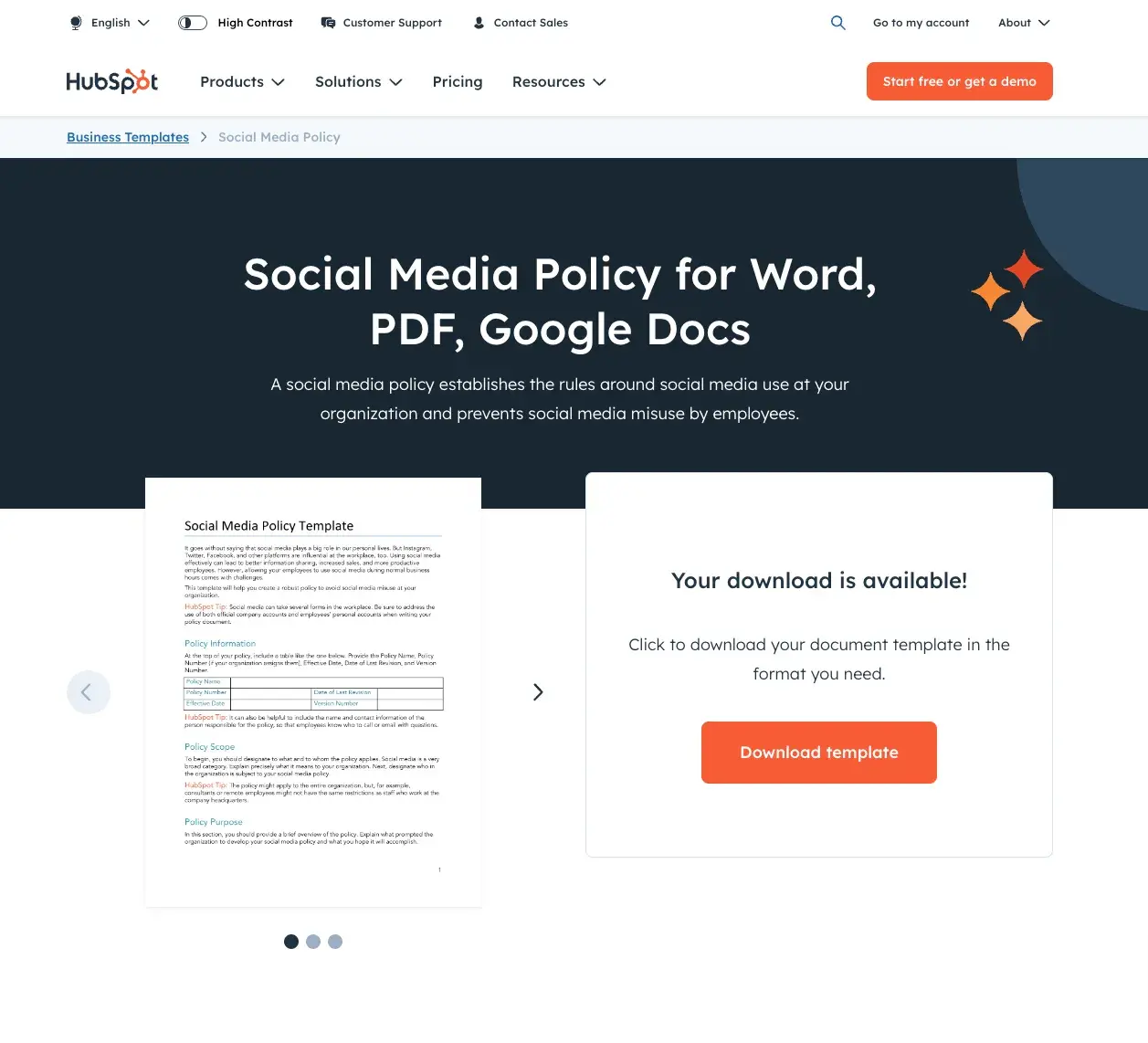
Need some putting yours together? Our free social media policy template will help you collect your thoughts into a formal document that can be downloaded as a Word document, Google doc, or PDF.
8 Examples of Great Social Media Policies
Let’s explore how prominent companies created effective social media policies to inspire your own today.
1. Best Buy
Image Source
Best Buy has a social media policy in place that preemptively addresses privacy concerns that could arise using social media.
What do I like about Best Buy’s social media policy?
- It looks out for both the employee and the company.
- It’s skimmable but specific about what matters (i.e., what information should never be shared)
- It’s written in direct, simple language that anyone could understand.
- It’s clear about the repercussions of breaking the policy.
- It gives you guidance on where to go for more information.
What could be better?
- It’s dated. The policy appears to be from 2010 and even calls out “tweeting” specifically. Companies should regularly update their social media policies to reflect new platforms, behaviors, and concerns.
2. Adobe
Adobe keeps it even shorter than Best Buy, including social media simply as a footnote its much longer “Code of Business.”
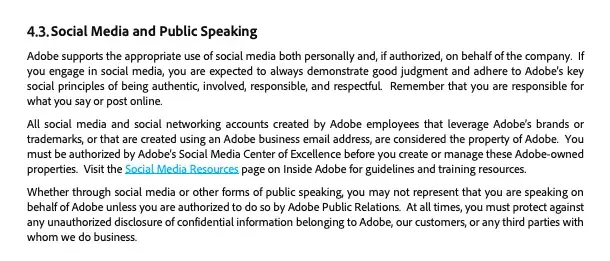
Image Source
What do I like about Adobe’s social media policy?
- It’s concise.
- It applies to multiple platforms.
- It links to additional resources.
What could be better?
- It’s vague. Unlike Best Buy’s policy, which was short but easy to understand, Adobe’s feels like there is much to interpret. For instance, “appropriate” can vary greatly depending on the person.
- It doesn’t mention what happens if the policy is broken.
- It’s cold and formal with its language.
3. Walmart
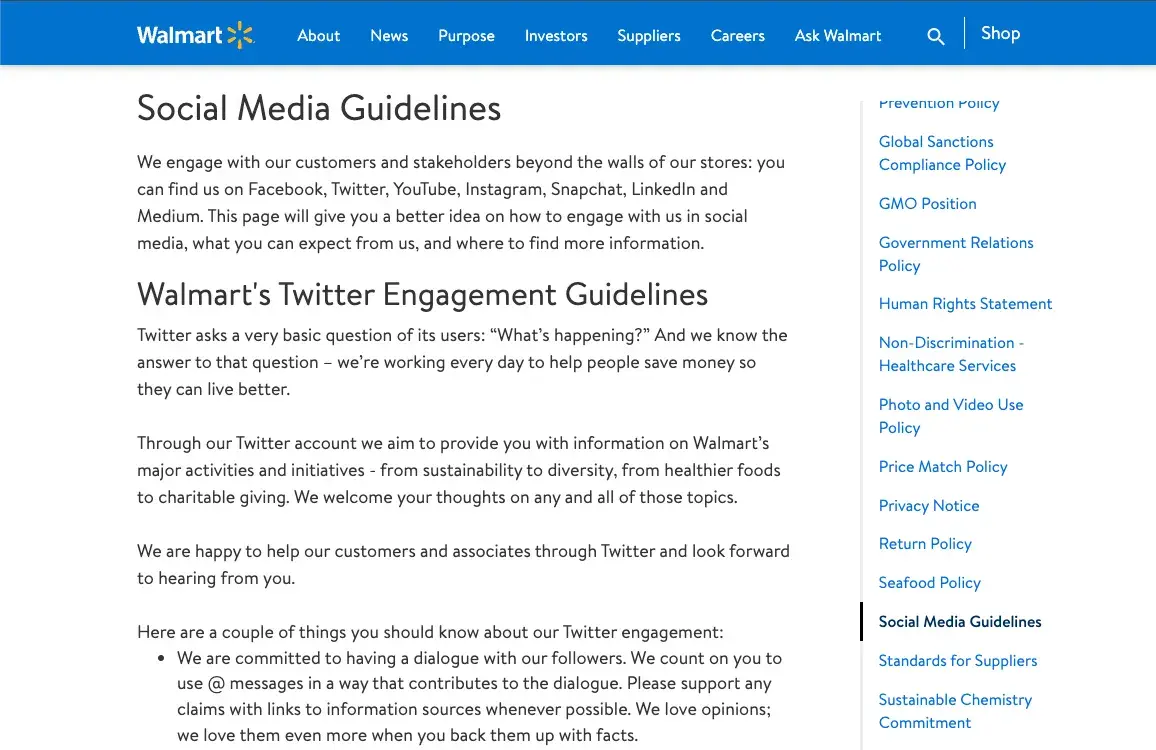
Image Source
Walmart is dedicated to its social media accounts and believes in social media as an avenue for customer service. Its social media policy mentions all the networks it has a presence on, zeroes in on Twitter (X), Facebook, and Instagram.
What do I like about Walmart’s social media policy?
- It’s written in direct, simple language that anyone could understand.
- It’s specific about what audiences can expect from them.
- It addresses both Walmart employees and official brand accounts.
What could be better?
- It would make sense to discuss the other platforms Walmart is active on as well: YouTube, Snapchat, LinkedIn, and Medium. There really is not explanation as to why they are not.
4. Ford Motors
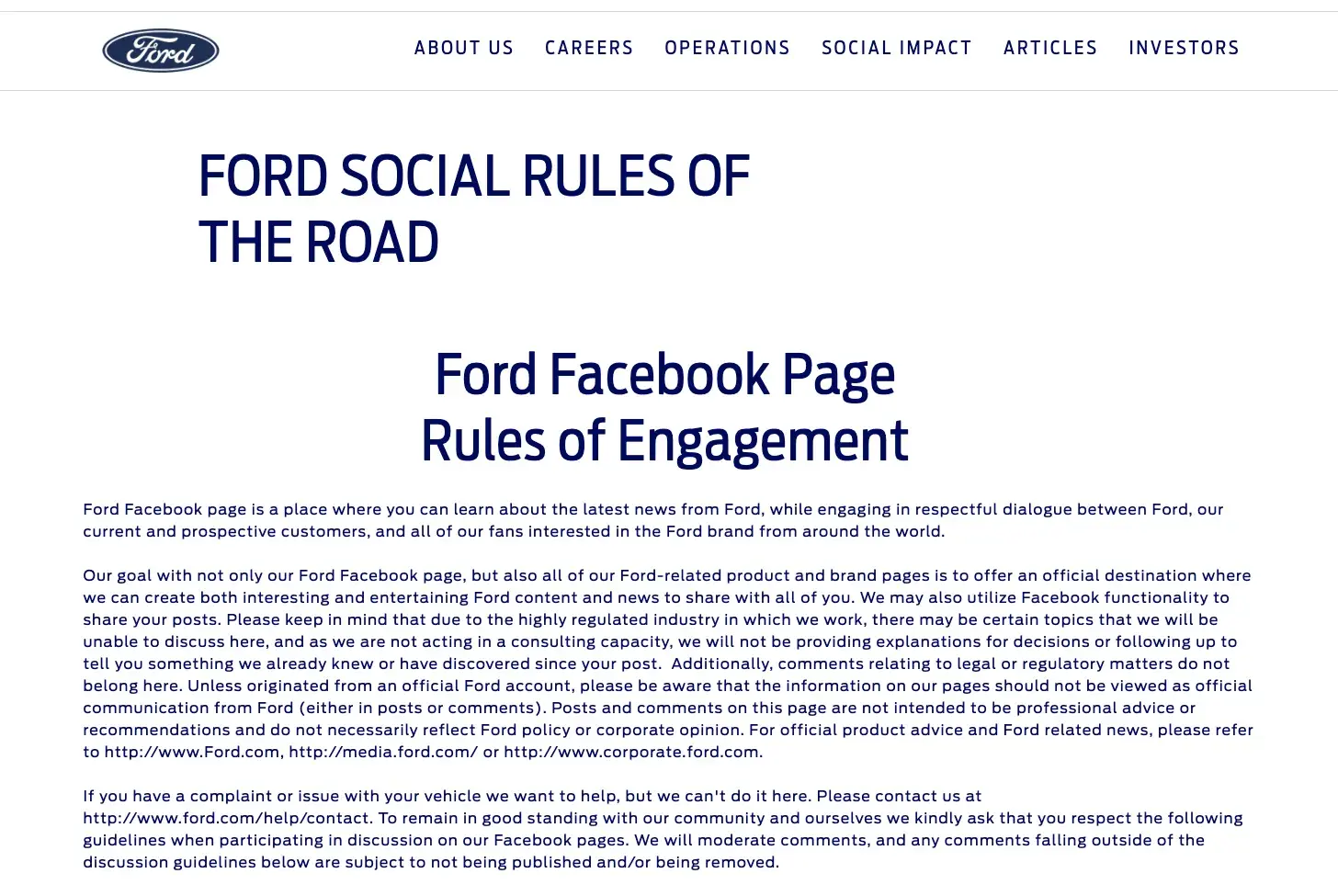
Image Source
Ford focuses solely on its Facebook page in its most current social media policy version.
A PDF of “Ford Motor Company’s Digital Participation Guidelines” is also circulating online, but it is over 14 years old and includes several rebranded social media networks.
What do I like about Ford’s social media policy?
- It takes a unifying and welcoming tone.
- It’s specific about what you can expect from them and the expectations of others in its “community.
- It’s clear about its rights and use of content on its page.
- It gives you guidance on where to go for more information.
What could be better?
- It focuses just on Facebook. It should be opened up to address other platforms, as Ford is active on Instagram and X, among others.
- It doesn’t offer guidelines on how employees of Ford should conduct themselves
5. Coca-Cola
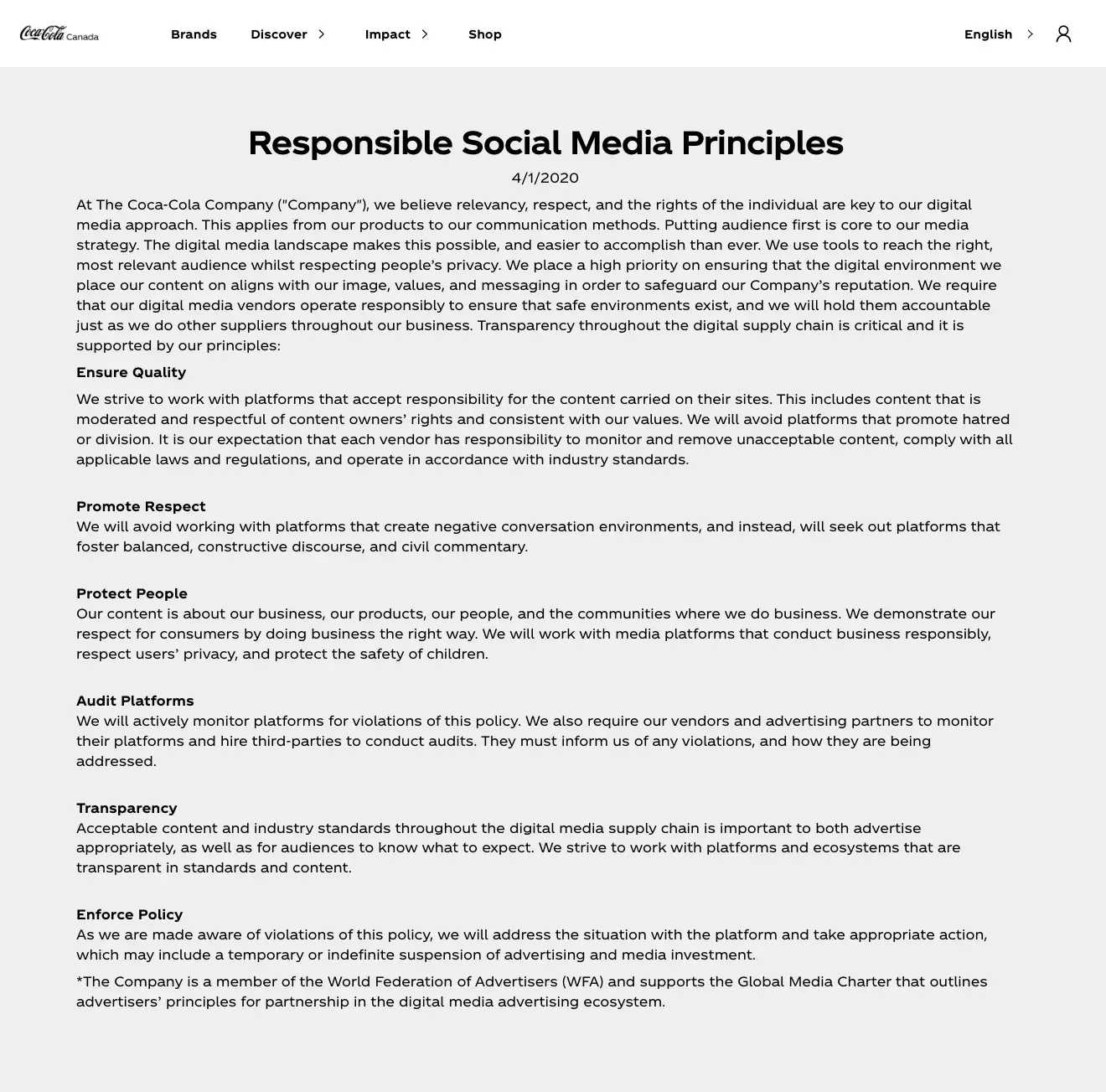
Image Source
Coca-Cola doesn’t have a social media policy in the traditional form, but rather “responsible social media principles” it promises to abide by.
This establishes a more timeless “brand” of social media for Coke rather than specific practices that may become dated quickly.
What do I like about Coke’s social media policy?
- It focuses on their impact and responsibilities to their audience.
- It establishes its values in detail with examples. For example, it explains that “platforms that accept responsibility for the content carried on their sites” partially means they must be moderated and free of hate or division.
- The principles are general enough to apply to any social platform or practice. This makes them timeless.
- It’s clear about what audiences can expect from Coke and what happens in the case of policy violations.
What could be better?
- It should include more specific guidelines for Coca-Cola employees.
- It should include intellectual property, brand, tone, and voice information.
Swaybase shares a document covering these items, but is unclear if this content is still in use.
6. The New York Times
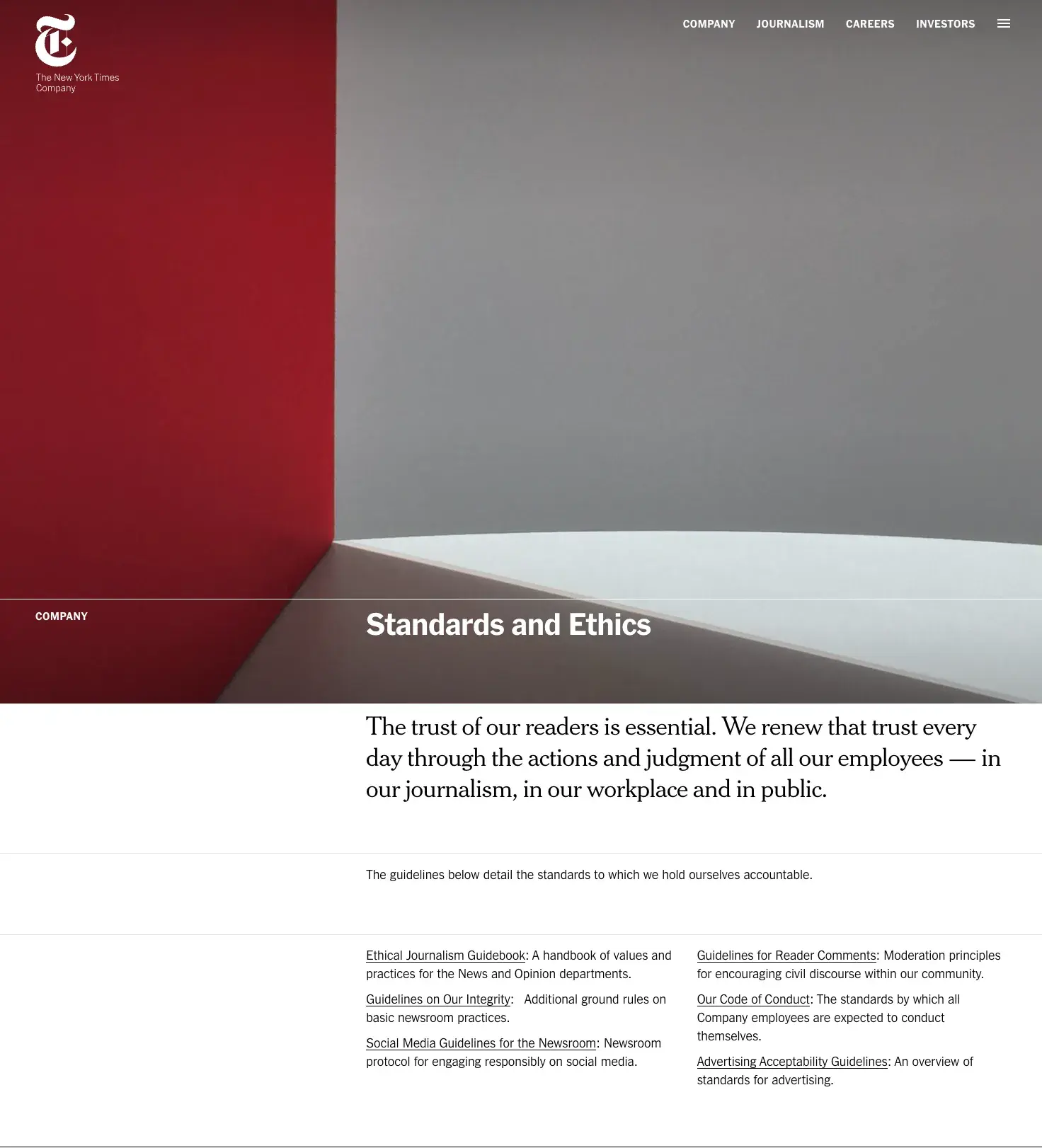
Image Source
The New York Times (NYT) recognizes the price of its popularity — namely, that anything its employees state on their personal accounts could come across as the official opinion of The Times.
It also recognizes how essential social media is to its position as a credible house of journalism, making that very clear in its social media policy.
What do I like about NYT’s social media policy?
- It’s current. Updated in June 2024, it’s the most recently created social media policy I’ve encountered.
- It’s extremely thorough and specific. This includes but is not limited to who and what platforms fall under the policy.
- Most points are actionable.
- It uses bullet points to make it easier to digest.
- It explains NYT’s development process. The policy was created by collecting insights and quotes from actual reporters. This provides additional accountability and a sense of fairness, as the points came from employees.
- It starts with “highlights” to draw attention to the most important pieces of the policy.
- It offers guidance on troubleshooting and where to reach out for more information.
What could be better?
- This is presented in many ways, like a NYT article. This is on brand, sure, but I’d have recommended it be presented in a less verbose and easier-to-skim format.
7. Oracle
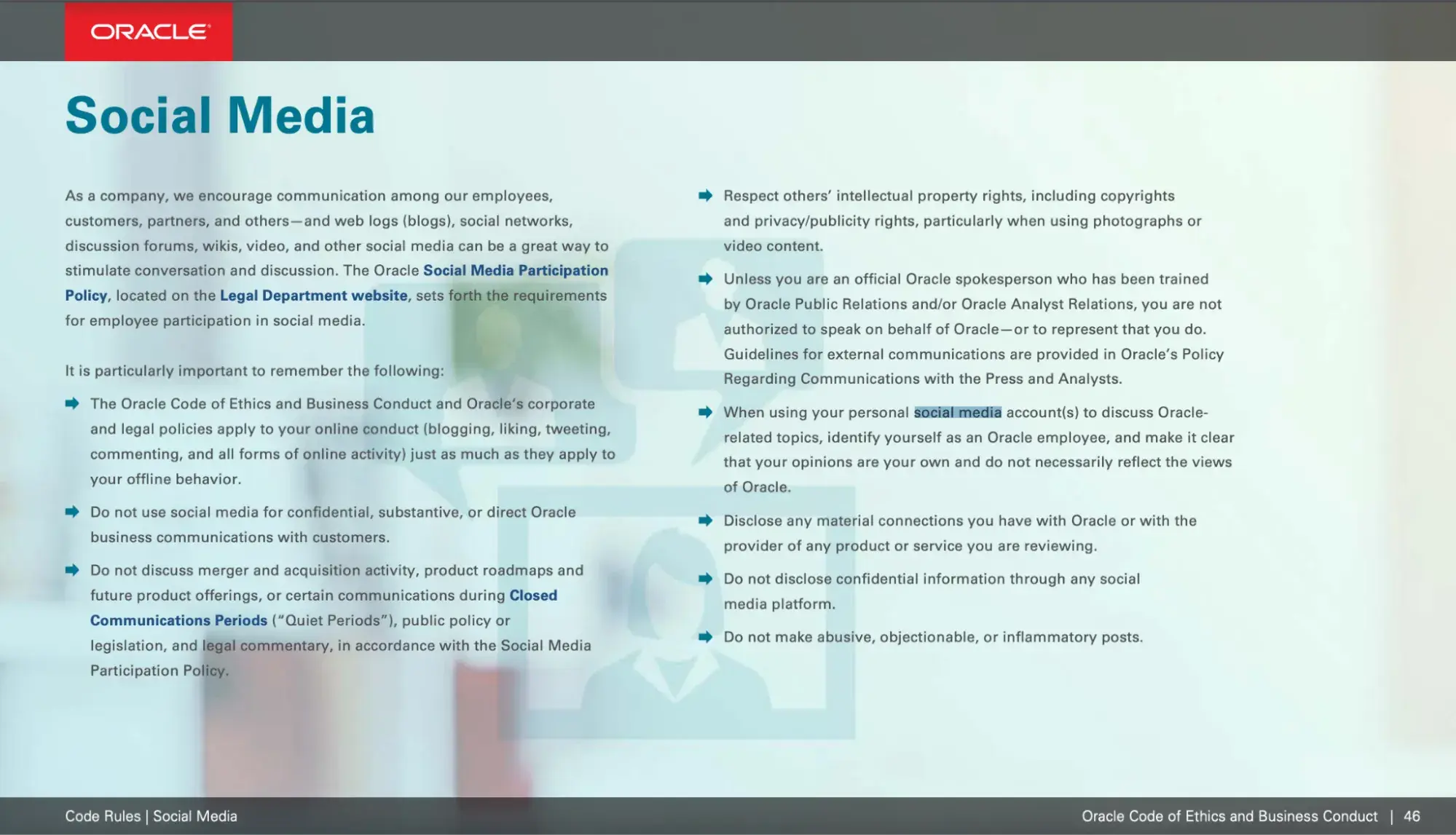
Image Source
Oracle is pretty tight-lipped about its social media practices. This is made apparent by reports in 2014 that they fired an employee for discussing their plans for X (then Twitter).
Oracle’s social media participation policy documents how social media is used as a business, but its employee code of conduct and business ethics touch on how employees can engage in personal social media.
What do I like about Oracle’s social media policy?
- It makes the “dos and don’ts” of social media for employees very clear.
- Its language is simple and easy to understand.
- It links to additional resources.
What could be better?
- It could provide more detail and examples of acceptable or unacceptable content/behavior online.
8. U.S. Department of Defense Social Media Policy
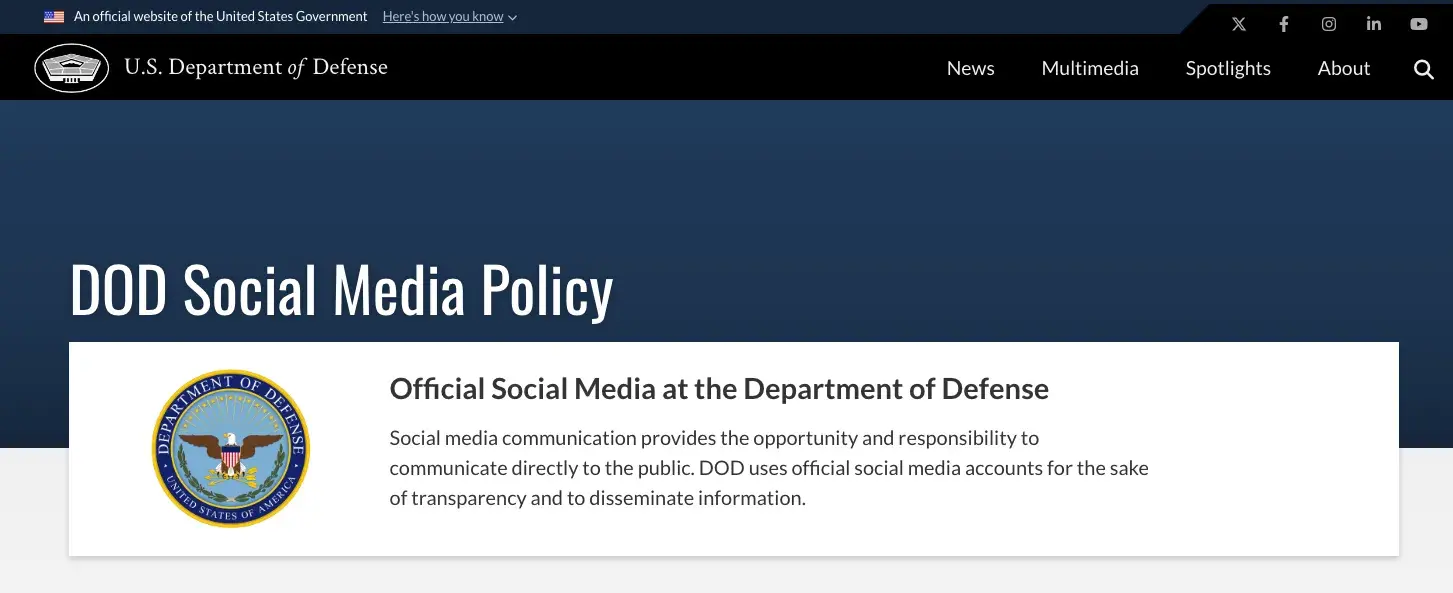
Image Source
Every organization should take precautions to make sure their classified information isn’t shared recklessly on social media. But this is even more critical for government agencies like the U.S. Department of Defense.
What do I like about Oracle’s social media policy?
- It’s concise and easy to skim.
- It links to related resources and makes those easy to find.
- It uses headers, bolding, and bullets to organize the information and draw attention to the most important parts.
What could be better?
- It focuses solely on how the DOD uses social media as an organization. It doesn’t speak to how DOD employees should approach social media, which seems important for a government agency.
- The language is formal and technical. I would simplify to avoid any confusion or misunderstanding. For instance, “disseminate” could easily be “share” despite coming from the government.
A great social media policy is step one.
Ultimately, the rules and regulations you choose to include in your policy should reflect your own brand’s values, messaging, and tone.
However, you can use these examples and guidelines to ensure you include statements that can help protect you against legal or regulatory disputes in the future based on an employee’s social media posts.
Additionally, aim to use your social media policy as your first step toward increasing the effectiveness of your social media strategies and ensuring a positive brand image on any platform on which you post.

این خبر را در ایران وب سازان مرجع وب و فناوری دنبال کنید
جهت دانلود و یا توضیحات بیشتر اینجا را کلیک نمایید